Friday, 10 June 2016

Nigerian Catfish Farmer Believes in “African Dream”

More and more young Africans are discovering that they can make farming a profitable career.
Enayon Anthony holding sack of feed next to pond (Courtesy Enayon Anthony)
Enayon Anthony pours feed into his catfish pond.
Enayon Anthony is from a rural part of Delta state in Nigeria. Anthony loved the catfish his mother raised and cooked for family meals throughout his youth. He even enjoyed feeding the fish. Eventually, he determined that fish could provide him with a livelihood.
“You can be a farmer and still make a good and honest living from it,” says the successful fish farmer and YALI Network member.
Anthony, 28, raises his stock with care. He buys fingerlings from a friend at a good price, feeds them nutritious commercial feed and regularly checks the quality of the water in his pond, which is connected to a river. If he determines that the pond’s water quality has declined or that the fish are not eating, he drains the pond and refills it with fresh water, which he treats to control bacteria.
“I have to check my fish every day,” he says.
It takes six months for fingerlings to grow to the size where they can be harvested and sold. “We sell the fish we harvest right on the farm,” Anthony says, adding that sales are good. His primary customers are local women fishmongers, who sell the catfish in local markets.
“It is profitable selling catfish compared to other farm products,” he says, adding that farm-grown fish are less expensive than river fish. His goal is to expand his catfish farm to become one of the largest in West Africa.
“A lot of youth are coming into catfish farming,” he says. “The future of catfish is very bright.”
He wants other YALI Network members to understand that agriculture “is one sector that can move Africa to the next level” by providing both income and employment opportunities.
Enayon Anthony holding sack of feed next to pond  (Courtesy Enayon Anthony)
Anthony prepares to harvest mature fish.
On a larger scale, Anthony says,“the agriculture sector is big. … Let’s feed Africa and beyond.”
Anthony praises the YALI Network for “really opening my eyes and mind to dreaming” and “meeting people of like minds who have the same dream about Africa.”
“I call it the #AfricanDream,” he says.
“I am personally committed to an Africa that works fairly for Africans of all ethnic and religious backgrounds,” he continues.
“Thanks for YALI.”

Credit: YALI

Catfish scarcity looms In Nigeria

credit: Wikipedia
Catfish may soon be out of the reach of the average Nigerian as the hike in prices of feeds has forced some fish farmers out of business, the News Agency of Nigeria (NAN) reports.
Some farmers who spoke to NAN yesterday in Lagos described the development as worrisome, calling on government to ensure price stability in the industry.

NAN reports that Skretting Feeds had in the first week of June increased the price of a bag of its 2mm feed from about N5,000 to N8,000.
A farmer, Mr Emmanuel Ogharegbe, said that many of his colleagues had since abandoned the business, due to arbitrary hike in the prices of feeds.
Ogharegbe said the price hike did not translate to an increase in the price of fish as fish traders operated a cartel that could frustrate any increase in per kilo price of fish.
Another farmer, Mrs Josephine Obi, wondered how she would survive if the price of feed continued to increase.
“On June 1, I received a text message from a woman who was selling feeds to me announcing an increase in the prices of feeds.
“Early this year, a Coppens Feeds increased its price and we shifted allegiance to Skretting Feeds. Now, the price of our new brand has increased by more than 50 per cent.
Her colleague, Mr Olushola Ogundele, who decried the hike in feed price, appealed to the Federal Government to come up with a policy that would ensure price stability in the agricultural sector.
Ogundele said that government’s intervention was critical to forestalling the scarcity of catfish in the country.
Another farmer, Mrs Beatrice Okpara, said that most of her colleagues were no longer in the farming business due to power outages and the increasing price of feeds.
“The price of fish meal, a major component for formulating fish feeds, increased from N500 per kilo to about N800 per kilo in the space of two months.
“If it continues like this, it will affect optimal production of fish,’’ Okpara said.
Also, Mr Joseph Makinde, a fingerlings producer, said the imported feeds were critical in raising fish in the early phase of their life.
Chief Tayo Akingbolagun, President of the Catfish Farmers Association of Nigeria, had on Jan. 11 told fish farmers to shun products from some feeds companies over their arbitrary hike in prices.
No immediate response from the Federal Ministry of Agriculture and Rural Development as at the time of filing this report yesterday.
Source: naija247news

Tuesday, 7 June 2016

Why we are investing in Agriculture – Kano Governor, Ganduje

ganduje
The Kano State Governor, Dr. Abdullahi Umar Ganduje says his administration is investing heavily in agriculture in order to increase the food security status of the state and boost the sector’s contribution to Internally Generated Revenue, IGR.
According to a statement issued on Monday by the Governor’s media aide, Salihu Tanko Yakasai, Ganduje made this assertion during the celebration of the state Farmers Day and inauguration of 381 Agricultural extension workers and distribution of motorcycles to them, at Kadawa in Garun Mallam local government area.
His words, “Oil money has dropped so the best option is for us to focus on agriculture so as to shore up our revenue, to enable us address the development needs of our people.
“We, as a leading wheat production state, have invested substantially in production of the commodity. For instance, the government provide N100 million interest-free loan to wheat farmers , drilled 1,000 tube wells, distributed 5, 000 hand pumps and procured two combined harvesters, clearing, sorting and grading machine, among others, to boost production”, the governor maintained.
The Governor also stated that efforts are on for the improvement of milk and meat production in the state as two Artificial Animal Insemination centers have already been established and equipped in the state.
He stated that the new agricultural extension workers were recruited to build the capacity of farmers even as the government is encouraging private sector investment across all the agricultural value chains.
In another development, Ganduje made a stopover at Gafan, also in Garun Malam local government area where he addressed Tomato farmers, whose produce were destroyed by “Tuta absoluta” locally referred as Tomato Ebola.
Tuta absoluta is a harmful leaf mining moth, also called tomato leaf miner and has a strong preference for the tomato plant. It has destroyed farmlands in Kano and across the country, which has made the price of tomatoes sky-rocket in the past few weeks.
The Governor, who lamented the huge amount of loss incurred by the farmers, said a census of the affected farmers is being carried out by the government while contact has already being established with two research institutes for provision of antidotes.
Some tomato growers who spoke with the Governor explained they had incurred more loss than victims of the recent fire outbreak at Sabon Gari market, worsening the prevailing harsh living condition in the country for them.

Source: Daily Post

Former Kenyan banker driving to success in car hire business

by 

lesus 600x300
Dan Njoroge
Uber, the world’s largest taxi company, owns no vehicles. Neither does Lesus Executive Car Hire, a vehicle hire company in Kenya.
Lesus provides chauffeured cars ranging from luxury sedans, sports utility vehicles (SUVs), stretch limousines, vintage cars, and also chartered helicopters and motorbike escort services to both individual and corporate clients. Dan Njoroge has run the company for the past three years.
In 2011 the journey of firsts began for him. Besides being the year he left the cushion of a promising career in finance at one of the leading banks in Kenya, it was also the start of a search for a more challenging job. Having been in banking for four years, he was confident of finding another opportunity, but to his surprise no doors opened.
By mid-2012, with his savings exhausted, he was forced to sell all his belongings and move out of his apartment while he figured out his next move. During this period he decided to try supplying stationary to corporates. He did so for the next six months earning him an average of just $10 a day, not forgetting the hard labour entailed given he had to at times trek over long distances carrying heavy supplies.
Frustrated and faced with lack of a reliable income, Njoroge decided to try out leasing his friend’s luxury 4×4 as he wasn’t using it. After a few days, someone offered him a job to chauffeur at a wedding followed by subsequent jobs, one which lasted two weeks.
This was a windfall given his meagre earnings at the time. “Getting payment for the two weeks’ job marked my defining moment. I figured I could also run an executive car hire business, add more cars and ultimately earn more. This, coupled with my passion for cars, birthed my business,” he says
Penetrating the market
The initial market penetration strategy for the company involved catering for weddings, which still comprises 70% of its business. This was mainly driven by referrals as well as online marketing through the website and social media.
The company also offered its vehicles for free to a leading media house during one of their events, which offered Lesus mileage in the form of publicity.
Creating a database of well-maintained luxury cars requires good contacts with high-value individuals as well as other executive car hire companies. Njoroge has managed to grow his network by being a trusted and reliable provider, which in turn made vehicle owners trust him with their cars as well as recommend others to him.
Iconic events catered for
The company was among the service providers for the 2015 Global Entrepreneurship Summit, which was headlined by US President Barack Obama. More recently, it catered to a Turkish government delegation.
According to Euromonitor International, the demand for car hire in Kenya continues to increase, driven by the growing number of business travellers.
Challenges present new opportunities
In a business largely driven by trust, the huge challenge has been to deliver to clients even when vehicles suppliers let him down.
“I once had a client request for a good number of luxury 4x4s, which I knew were hard to come by – but I let them know well in advance I’ll try my best but the cars were not readily available. However a few anxious hours and multiple calls later, I’d gotten hold of the requested number of vehicles, ready for the event starting the next day. Both my client and I breathed a sigh of relief,” he recalls. Needless to say this opened more opportunities and repeat orders from the same client.
For now, Njoroge is concentrating on growing his brand. In his words: “I dedicate 90% of my time and money to build my brand and leave only 10% to myself. I’m living the concept of delayed gratification, because I know that once my business is able to stand on its own, I can then focus on living the life I’ve always wanted.”

Tanzanian entrepreneur quits banking job for hot ice cream idea

by 

Mercy Kitomari
Mercy Kitomari
Tanzanian Mercy Kitomari quit her banking job in 2013 to pursue her vision of making frozen desserts. She is founder and CEO of Nelwa’s Gelato, an ice cream business operating in the financial hub of Dar es Salaam.
Her interest in ice cream began while she was studying for an MBA in the UK. She worked part time as a tour guide, and after every sightseeing trip she would take visitors to ice cream parlours at Leicester Square in the heart of London.
“There were ice cream parlours everywhere,” she recalls. “[In Tanzania] we drink a lot of tea and alcohol. But my mission is to influence a culture of frozen desserts. I want frozen desserts to be a normal indulgence, not a luxury. And I want to see ice cream parlours everywhere.”
After she completed her studies, Kitomari took up a job at a bank in Tanzania. In 2012 she started making ice cream from her mother’s kitchen and eventually quit her job to run her business full-time.
Today she operates an outlet in Dar es Salaam, sells to hotels and restaurants, and also makes home deliveries.
Since Kitomari cannot currently afford to open many physical outlets, she has also partnered with bakeries to expand her reach. She provides branded freezers to independent bakeries, which then buy ice cream from her in bulk.
“If I see the location has good traffic I just give them my branded freezer and I train them how to make waffles and milkshakes, and how to scoop ice cream. This is the bigger picture. When we get to factory level we will just supply to such businesses. This would make it easier for me to have a wider geographical reach in Tanzania, and Africa. It fits well into my goal to have ice cream parlours everywhere – just like I saw them in Leicester Square.”
Changing consumer behaviour
Kitomari notes there are various factors that make Dar es Salaam a good location to build an ice cream business. For starters, the coastal city has hot and humid weather during most of the year.
Additionally, she notes Dar es Salaam is experiencing fast economic growth with many consumers now able to afford more than just their basic needs. At Nelwa’s Gelato, a cup of ice cream sells for just under US$2 (TZS.4,000), and Kitomari says there are customers who buy every day.
“Some people are getting into the job market and others are running their own businesses, so they are starting to make some money. I even have a few addicts – when their favourite flavour runs out they get really get mad at me. The city is changing very fast. I get consumers who request me to make flavours they saw online. Consumers are paying attention to what’s happening in other markets and they are willing to try new things.”
“Tanzania also produces lots of fruits of different variety. Instead of just making juices, we have an opportunity to make nice desserts too. We even make rubber vine and jackfruit flavoured ice cream – which are not common flavours in other places.”
Going head-to-head with bigger brands
But breaking into Tanzania’s ice cream business is no mean feat. There are some established players with deeper pockets. One of the leading brands is called Azam, manufactured by Bakhresa Group, a family-owned diversified conglomerate.
“My industry is seen as an industry for giants. There are big brands such as Azam and Fairy Delights. There are also other companies that are set up in shopping malls where I cannot afford to lease space at the moment,” says Kitomari. “In Tanzania, people say Azam when they want ice cream. It is a very strong brand. To break into such a market, you really have to engage consumers.
“We have to explain that this is a different product – it is gelato made the Italian way [and] it costs a bit more because it is luxurious. They also have to try it. In our shop you can taste up to five flavours, and usually after tasting people will say, ‘ahh this is different’. That strategy is working.”
The business also faces challenges accessing raw materials due to a shortage of products such as skimmed milk, seasonality of fruits and general supply chain weaknesses.
“I am not where I want to eventually be – but I’ve learnt to work with what I have to get to my vision,” explains Kitomari. “For my fellow Tanzanians, I want them to wake up to opportunities… Many people have ideas but are afraid to go for it. It is a difficult journey, but do it. Don’t wait for investors to come give you money for you to get started on your dream.”

How drones can curb the cost and time of designing farms in Africa

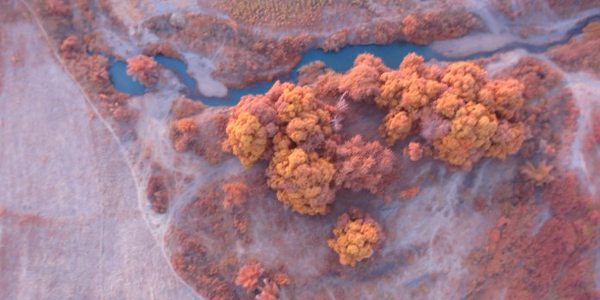
An image taken by a drone over potential farmland in northern Nigeria.
An image taken by a drone over potential farmland in Nigeria.
This year a drone helped design the irrigation system for a 3,000ha rice farm in Nigeria – about 75km from the town New Bussa.
Careful water management is an essential part of cultivating rice as water levels impact weed and nutrient distribution. To ensure that paddy fields are constructed around optimal water levels, land surveyors need to review the land and map out areas suitable for rice farms. Heavy earth-moving and farming machinery are then brought in to level the land (another vital part of rice cultivation) and develop the basins – which can be especially costly in rural areas with poor road infrastructure.
Previous site visits to this particular farm in Nigeria had resulted in the assumption that rice fields should be built as large rectangular basins to optimise water management. But, before the machines were brought in, a drone proved this would in fact result in an expensive mistake.
Slashing land-surveying costs and time
GMX Consulting is a London-based agriculture advisor, developer and operator focusing specifically on Africa. It brings in Vietnamese expertise to develop and manage agricultural production systems for rice, cassava, tomatoes and fish. The company handles everything from feasibility studies to project design and operation.
The business has also recently launched a drone-based farming application service to help reduce the time and cost of surveying farmland in Africa. Images taken from a drone can help with management decisions around irrigation design. Drones can do in days what manual surveying does in months and are a cheaper alternative to manned aircrafts.
In northern Nigeria, for example, 7,500ha of land had to be surveyed to plot out the terrain for a 3,000ha rice farm. According to Quan Le, managing director of GMX Consulting, it takes two surveyors about three months to map only half of this area. The drone on the other hand can map 1,000ha a day. The reduced time also means reduced costs, as surveyors no longer have to stay in hotels for months on end.
While surveyors are still required to “get a feel of the land”, Le said the drone was able to spot things that traditional surveying missed. Instead of building large rectangular paddy fields in northern Nigeria, the drone’s topography images of an undulating landscape revealed it would be better to build narrow rice fields that followed the terrain and made use of a completely different irrigation system.
“The drone gave us a very good overview of the sloping nature of the soil… So they helped us change our hypothesis. It could have been changed by us continuing with the traditional method of surveying, but that would take much longer to do,” noted Le.
Today about 500ha of rice farmland has been developed and Le expects harvesting to begin within six months.
“That will be exciting… To be able to actually say you are responsible for a few thousand tonnes of rice that will be consumed by the people – it is a special feeling because you know the whole process and how difficult it is to produce food. But hopefully over time – with technology, skills and investment – it will become easier so people will have more food to eat and everyone involved, including our investors, will make money from it. That is the only way it will become sustainable.”
GMX is currently also using drones to survey potential farmland in Sierra Leone, Senegal and elsewhere in Nigeria.

Thursday, 2 June 2016

11 states donate 55,000 hectares for grazing project

Abuja – Minister of Agriculture and Rural Development, Chief Audu Ogbeh says 11 states have provided 55,000 hectares to establish ranches to curb farmers and pastoralists clashes in their states. Ogbeh made this known at a news conference on Thursday in Abuja. Ogbeh said the states are Plateau, Kaduna, Kano, Gombe, Katsina, Taraba, Niger, Adamawa, Jigawa, Sokoto and the FCT.

He said of all the enterprise in the livestock sector, only the poultry industry had achieved an appreciable level of commercialisation. Ogbeh said other industries in the livestock sector were predominantly in the hands of subsistence farmers with pastoralist system of production contributing over 90 per cent of cattle production in the country. 

He said the 2011 National Agricultural Sample Survey indicated that Nigeria was endowed with an estimated 19.5 million cattle, 72.5 million goats, 41.3 million sheep, 7.1 million pigs and 28,000 camels. Accordingly, the minister said the country had 145 million chickens, 11. 6 million ducks, 1.2 million turkeys and 974, 499 donkeys. Ogbeh said this impressive statistics which had made Nigeria number one in livestock in Africa had not met the national demand of animal protein or contributed to the GDP over the years. He decried the low milk production in Nigeria as a cow produced one litre of milk a day while a cow in Saudi Arabia or Brazil produced 30 to 40 litres. “Saudi Arabia produces 4.7 million litres of milk daily while Nigeria imports about 1.3 billion dollar worth of milk annually to make up deficit.

 “The way forward in improving our livestock and dairy industry is to intensify efforts on adding value to the industry along the respective livestock value chains. “In line with our goal of attaining self sufficiency in animal protein, this administration has set out to establish ranches to be planted with high quality improved tropical grass and legume species. “We shall provide irrigation for all year commercial fodder production to enhance settlement of pastoralist and ensure cattle, sheep and goat improvement through an expanded breeding programme through artificial insemination. “We shall group dairy farmers in clusters, build their capacity and equip them with milk collection facilities and facilitate single digit loan for them,’’ he said.

The minister said there was a new disease outbreak affecting maize production in some parts of Edo and in the South West of the country. He gave the name of the disease as “army worm’’, adding that relevant research institutes were working on it and the ministry was monitoring the level of threat it posed. Ogbeh urged farmers not to panic, adding that the ministry would take further action if the disease is not controlled within a short time.

Source: Vanguard