Tuesday, 7 June 2016

Tanzanian entrepreneur quits banking job for hot ice cream idea

by 

Mercy Kitomari
Mercy Kitomari
Tanzanian Mercy Kitomari quit her banking job in 2013 to pursue her vision of making frozen desserts. She is founder and CEO of Nelwa’s Gelato, an ice cream business operating in the financial hub of Dar es Salaam.
Her interest in ice cream began while she was studying for an MBA in the UK. She worked part time as a tour guide, and after every sightseeing trip she would take visitors to ice cream parlours at Leicester Square in the heart of London.
“There were ice cream parlours everywhere,” she recalls. “[In Tanzania] we drink a lot of tea and alcohol. But my mission is to influence a culture of frozen desserts. I want frozen desserts to be a normal indulgence, not a luxury. And I want to see ice cream parlours everywhere.”
After she completed her studies, Kitomari took up a job at a bank in Tanzania. In 2012 she started making ice cream from her mother’s kitchen and eventually quit her job to run her business full-time.
Today she operates an outlet in Dar es Salaam, sells to hotels and restaurants, and also makes home deliveries.
Since Kitomari cannot currently afford to open many physical outlets, she has also partnered with bakeries to expand her reach. She provides branded freezers to independent bakeries, which then buy ice cream from her in bulk.
“If I see the location has good traffic I just give them my branded freezer and I train them how to make waffles and milkshakes, and how to scoop ice cream. This is the bigger picture. When we get to factory level we will just supply to such businesses. This would make it easier for me to have a wider geographical reach in Tanzania, and Africa. It fits well into my goal to have ice cream parlours everywhere – just like I saw them in Leicester Square.”
Changing consumer behaviour
Kitomari notes there are various factors that make Dar es Salaam a good location to build an ice cream business. For starters, the coastal city has hot and humid weather during most of the year.
Additionally, she notes Dar es Salaam is experiencing fast economic growth with many consumers now able to afford more than just their basic needs. At Nelwa’s Gelato, a cup of ice cream sells for just under US$2 (TZS.4,000), and Kitomari says there are customers who buy every day.
“Some people are getting into the job market and others are running their own businesses, so they are starting to make some money. I even have a few addicts – when their favourite flavour runs out they get really get mad at me. The city is changing very fast. I get consumers who request me to make flavours they saw online. Consumers are paying attention to what’s happening in other markets and they are willing to try new things.”
“Tanzania also produces lots of fruits of different variety. Instead of just making juices, we have an opportunity to make nice desserts too. We even make rubber vine and jackfruit flavoured ice cream – which are not common flavours in other places.”
Going head-to-head with bigger brands
But breaking into Tanzania’s ice cream business is no mean feat. There are some established players with deeper pockets. One of the leading brands is called Azam, manufactured by Bakhresa Group, a family-owned diversified conglomerate.
“My industry is seen as an industry for giants. There are big brands such as Azam and Fairy Delights. There are also other companies that are set up in shopping malls where I cannot afford to lease space at the moment,” says Kitomari. “In Tanzania, people say Azam when they want ice cream. It is a very strong brand. To break into such a market, you really have to engage consumers.
“We have to explain that this is a different product – it is gelato made the Italian way [and] it costs a bit more because it is luxurious. They also have to try it. In our shop you can taste up to five flavours, and usually after tasting people will say, ‘ahh this is different’. That strategy is working.”
The business also faces challenges accessing raw materials due to a shortage of products such as skimmed milk, seasonality of fruits and general supply chain weaknesses.
“I am not where I want to eventually be – but I’ve learnt to work with what I have to get to my vision,” explains Kitomari. “For my fellow Tanzanians, I want them to wake up to opportunities… Many people have ideas but are afraid to go for it. It is a difficult journey, but do it. Don’t wait for investors to come give you money for you to get started on your dream.”

How drones can curb the cost and time of designing farms in Africa

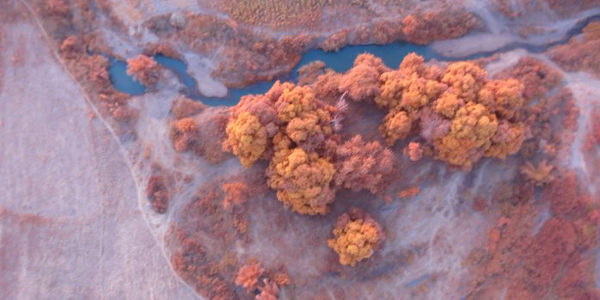
An image taken by a drone over potential farmland in northern Nigeria.
An image taken by a drone over potential farmland in Nigeria.
This year a drone helped design the irrigation system for a 3,000ha rice farm in Nigeria – about 75km from the town New Bussa.
Careful water management is an essential part of cultivating rice as water levels impact weed and nutrient distribution. To ensure that paddy fields are constructed around optimal water levels, land surveyors need to review the land and map out areas suitable for rice farms. Heavy earth-moving and farming machinery are then brought in to level the land (another vital part of rice cultivation) and develop the basins – which can be especially costly in rural areas with poor road infrastructure.
Previous site visits to this particular farm in Nigeria had resulted in the assumption that rice fields should be built as large rectangular basins to optimise water management. But, before the machines were brought in, a drone proved this would in fact result in an expensive mistake.
Slashing land-surveying costs and time
GMX Consulting is a London-based agriculture advisor, developer and operator focusing specifically on Africa. It brings in Vietnamese expertise to develop and manage agricultural production systems for rice, cassava, tomatoes and fish. The company handles everything from feasibility studies to project design and operation.
The business has also recently launched a drone-based farming application service to help reduce the time and cost of surveying farmland in Africa. Images taken from a drone can help with management decisions around irrigation design. Drones can do in days what manual surveying does in months and are a cheaper alternative to manned aircrafts.
In northern Nigeria, for example, 7,500ha of land had to be surveyed to plot out the terrain for a 3,000ha rice farm. According to Quan Le, managing director of GMX Consulting, it takes two surveyors about three months to map only half of this area. The drone on the other hand can map 1,000ha a day. The reduced time also means reduced costs, as surveyors no longer have to stay in hotels for months on end.
While surveyors are still required to “get a feel of the land”, Le said the drone was able to spot things that traditional surveying missed. Instead of building large rectangular paddy fields in northern Nigeria, the drone’s topography images of an undulating landscape revealed it would be better to build narrow rice fields that followed the terrain and made use of a completely different irrigation system.
“The drone gave us a very good overview of the sloping nature of the soil… So they helped us change our hypothesis. It could have been changed by us continuing with the traditional method of surveying, but that would take much longer to do,” noted Le.
Today about 500ha of rice farmland has been developed and Le expects harvesting to begin within six months.
“That will be exciting… To be able to actually say you are responsible for a few thousand tonnes of rice that will be consumed by the people – it is a special feeling because you know the whole process and how difficult it is to produce food. But hopefully over time – with technology, skills and investment – it will become easier so people will have more food to eat and everyone involved, including our investors, will make money from it. That is the only way it will become sustainable.”
GMX is currently also using drones to survey potential farmland in Sierra Leone, Senegal and elsewhere in Nigeria.

Thursday, 2 June 2016

11 states donate 55,000 hectares for grazing project

Abuja – Minister of Agriculture and Rural Development, Chief Audu Ogbeh says 11 states have provided 55,000 hectares to establish ranches to curb farmers and pastoralists clashes in their states. Ogbeh made this known at a news conference on Thursday in Abuja. Ogbeh said the states are Plateau, Kaduna, Kano, Gombe, Katsina, Taraba, Niger, Adamawa, Jigawa, Sokoto and the FCT.

He said of all the enterprise in the livestock sector, only the poultry industry had achieved an appreciable level of commercialisation. Ogbeh said other industries in the livestock sector were predominantly in the hands of subsistence farmers with pastoralist system of production contributing over 90 per cent of cattle production in the country. 

He said the 2011 National Agricultural Sample Survey indicated that Nigeria was endowed with an estimated 19.5 million cattle, 72.5 million goats, 41.3 million sheep, 7.1 million pigs and 28,000 camels. Accordingly, the minister said the country had 145 million chickens, 11. 6 million ducks, 1.2 million turkeys and 974, 499 donkeys. Ogbeh said this impressive statistics which had made Nigeria number one in livestock in Africa had not met the national demand of animal protein or contributed to the GDP over the years. He decried the low milk production in Nigeria as a cow produced one litre of milk a day while a cow in Saudi Arabia or Brazil produced 30 to 40 litres. “Saudi Arabia produces 4.7 million litres of milk daily while Nigeria imports about 1.3 billion dollar worth of milk annually to make up deficit.

 “The way forward in improving our livestock and dairy industry is to intensify efforts on adding value to the industry along the respective livestock value chains. “In line with our goal of attaining self sufficiency in animal protein, this administration has set out to establish ranches to be planted with high quality improved tropical grass and legume species. “We shall provide irrigation for all year commercial fodder production to enhance settlement of pastoralist and ensure cattle, sheep and goat improvement through an expanded breeding programme through artificial insemination. “We shall group dairy farmers in clusters, build their capacity and equip them with milk collection facilities and facilitate single digit loan for them,’’ he said.

The minister said there was a new disease outbreak affecting maize production in some parts of Edo and in the South West of the country. He gave the name of the disease as “army worm’’, adding that relevant research institutes were working on it and the ministry was monitoring the level of threat it posed. Ogbeh urged farmers not to panic, adding that the ministry would take further action if the disease is not controlled within a short time.

Source: Vanguard

Wednesday, 1 June 2016

Meet the Tryctor: A motorbike-turned-tractor targeting small farmers in Nigeria

Nigerian automobile designer Olufemi Odeleye spend near 10 years developing a low-cost, multipurpose, mini tractor – created with the African small-scale farmer in mind.
Nigerian automobile designer Olufemi Odeleye spent nearly 10 years developing a low-cost, multipurpose, mini tractor – created with the African small-scale farmer in mind.
While Nigeria’s agriculture sector employs the majority of the population and has a large contribution towards GDP, its true potential has yet to be unlocked.
The UN’s International Fund for Agricultural Development (IFAD) estimatesthat only half of the country’s 71 million hectares of arable land is being cultivated, with irrigation on just 7% of irrigable land. And over the years local food production has not been able to keep up with population growth, resulting in rising food imports and prices. In fact, recent statistics reveal that Nigeria is spending ₦1.3tr ($6.5bn) annually importing food.
Part of the challenge is at least 80% of the country’s food is being produced by small-scale and subsistence farmers, who struggle to increase production. Most live in poverty and do not have the finances to improve farming yields through mechanisation. As a result they are forced to cultivate the land by hand and battle to move beyond subsistence.
It was knowledge of this that prompted Nigerian automobile designer Olufemi Odeleye to spend nearly 10 years developing the prototype for a low-cost, multipurpose, mini tractor – created with the Nigerian, and African, small-scale farmer in mind. His invention, dubbed the Tryctor, has been adapted from the traditional motorcycle and caught the attention of the Nigerian government which is currently piloting the solution among farmers. And this year Odeleye and his Tryctor are up for the Innovation Prize for Africa.
Make do with what you have
Odeleye spent years working for the automotive industry in the UK before returning to Nigeria with the hope of using his skills to benefit his home country.
“I identified the need to contribute to the number one Millennium Development Goal – to eradicate extreme hunger and poverty. I studied automobile design in the UK and on my return to Nigeria I started looking for ways in which I could contribute.”
His grandfather had been a farmer and Odeleye knew that unlocking the country’s agricultural potential could play a key role in eradicating poverty and hunger. Then, in 2004, he got the idea for the Tryctor while sitting in Nigerian traffic and watching hundreds of motorcycles zigzag around vehicles.
“It has always been my design philosophy that you should use things you have at your disposal to solve problems. So I saw the motorbikes and I thought I should be able to use them to do something… When I got home I immediately put pen to paper and did some sketches and modified a motorbike and about a month later I made a prototype, which was basically the first of seven prototypes,” he explained.
“And that is how I started. I saw that opportunity; it came to me in a light-bulb moment.”
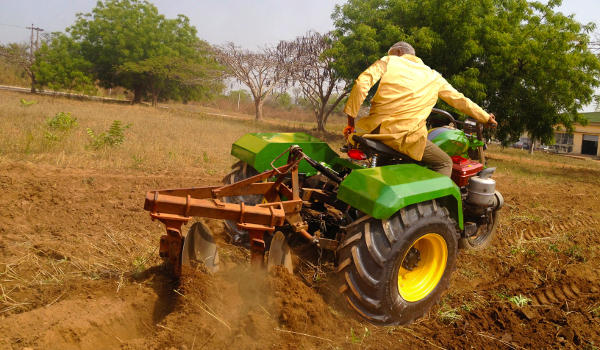
The final solution is a three-wheel mini-tractor with tyres suitable for farming and a 30-horsepower engine that can be used as a generator. Alterations to a motorbike’s chassis and gearing system means it operates similarly to a traditional tractor, and it comes with various farming implements – a disc plough, harrow and trailer – which can be attached to improve production, supply markets and ultimate increase revenue.
The Tryctor ploughing a field.
“A lot of crops go to waste – as much as 40% in some areas – and this is largely due to the fact that rural farmers don’t have access to the markets in nearby towns or storage facilities where they can take their grains to be stored for the next harvest,” explained Odeleye.
“The Tryctor can solve this because it comes with a trailer which can be attached to easily transport harvests from farms to storage facilities or nearby markets for sale.”
Furthermore, its engine can be used to power processing machines, such as those used for shelling maize, as well as irrigation pumps. “And it can also provide an alternative source of electricity so a farmer could always use it to power his home. It is a multipurpose tractor which brings value to the small-scale farmer in terms of increasing their income and improving their standards of living basically.”
Reducing costs
According to Odeleye, traditional tractors in the market are priced around ₦4m (about $20,000) – and that is without including the cost of necessary farming implements. On the other hand the Tryctor, together with the three implements, is currently priced at ₦1.9m ($9,500). Maintenance costs are also lower as around 60% of its parts can be locally sourced.
But Odeleye highlights that this is still unaffordable to the majority of smallholder farmers.
“Even if it costs $2,000, the reality is that in Africa you don’t really get smallholder farmers who can afford that.”
However, he sees potential in implementing a renting model through partnerships with agricultural equipment companies and other organisations.
“We are also targeting farming cooperatives that normally have better buying power than single farmers,” he added.
“The whole idea is farming cooperatives can come together, buy maybe two or five, and share them among their members. They can then also rent it out to other farmers to generate income. So those are the routes which we are looking at.”
In 2013 the Nigerian government financed the first 10 to be manufactured and started testing them in the market seven months ago. “We should be concluding the pilot programme by the end of this year and then we can begin fully commercialising it.”
So what is Odeleye’s advice to others looking to bring innovative solutions to the African market? Follow your passion, use the resources and skills you have, and always remember there is more than one way of doing things.
“Look around you. If you genuinely have a desire to help Africa, then look at things relating to your field… or areas you are able to contribute to. There is always an alternative way to doing things and it might end up being simpler, easier and cheaper than conventional ways. So as long as you have that mindset you will be able to innovate. And if you have passion, it will drive you through the whole, difficult process of bringing it to success.”

Tuesday, 31 May 2016

An All-Volunteer Squad Of Farmers Is Turning Florida Lawns Into Food

Rows of greens grow on the front yard of Gary Henderson's house. He's one of a handful of homeowners in Orlando, Fla., who've given up their lawn to Fleet Farming. Once "you realize that you can eat your lawn, I think it makes a whole lot of sense," Henderson says.
Catherine Welch/WMFE
In Florida, homeowners have a propensity for landscaping. They take great pride in the green carpet of grass in front of their homes. But one Florida man is working on a project that's turning his neighbors' lawns into working farms.
Chris Castro has an obsession — turning the perfectly manicured lawns in his Orlando neighborhood into mini-farms.
"The amount of interest in Orlando is incredibly surprising," Castro says.
Surprising because he's asking Floridians to hand over a good chunk of their precious yards to volunteers who plant gardens full of produce. His program is called Fleet Farming, and it's starting off small, with 10 of these yard farms. Most of them sit smack in the middle of the front yard.
Lawns are a thing here. Urban farms? Not so much. But so far, no neighbors have complained.
Fleet Farming volunteers Michele Bimbier, A.J. Azqeta and Blake Addington prepare freshly picked vegetables.
Catherine Welch/WMFE
"We've been lucky," Castro says.
Castro squeezes this project around his day job: He works on sustainability in the mayor's office. Castro's parents are palm tree farmers in south Florida, and he has a degree in environmental science — a background that's a perfect combination of his day job and side project. Thanks to his work in City Hall, he knows Orlando allows residents to farm on up to 60 percent of their yard.
Castro makes sure every garden is meticulously maintained — including homeowner Gary Henderson's.
"I just think that the whole idea of lawns, especially in a place like Florida, is absurd," says Henderson, standing amid rows of tomatoes, sweet lettuce, carrots and arugula growing smack in the middle of his front yard. Henderson donated the use of his yard about a year ago, after noticing other Fleet Farming gardens on his block.
"If you look across the street there, there's a garden," Henderson says as we stand outside in his yard. "That's my partner's daughter's house. I looked the other way, and there's one at the church, and [I] said, this might be something good to get involved with."
All of Fleet Farming's volunteers only ride bikes, going from garden to garden to harvest the produce. They were just at Henderson's garden.
"The Fleet people came in a swarm of bicycles," Castro says. "There were probably 15 people here, and they harvested lettuce and kale and arugula and, gosh, not even sure what else they had, Swiss chard."
Because the program is bike-powered, Castro keeps the yard gardens within a mile of the local farmers market, where Fleet Farming sells most of the produce.
Fleet Farming produce for sale at a farmers market in Orlando, Fla.
Catherine Welch/WMFE
When I visit the farmers market, Michele Bimbier is working the booth at the market, selling produce she and a few volunteers picked and washed just that morning. Lisa Delmonte saw Bimbier riding her bike to the market, and stopped by for some veggies. She's a fan for two reasons — the produce is local, and she says it tastes better than produce that's bumped around in the back of a delivery truck.
"I think the things that I buy at the grocery store — even the organic things at the grocery store — just don't have flavor," Delmonte says.
Along with sales at the farmers market, Castro sells kits to start Fleet Farming in other communities. There's a Fleet Farming program in Oakland, Calif., selling produce to local restaurants.
Among Fleet Farming's fans is Curtis Stone, a Canadian author and farmer who tours the U.S. spreading the gospel of urban farming. (He's got a farm in his yard.) He says Fleet Farming's patchwork of donated yards delivers more than local access to fresh produce.
"Land is often out of reach for many young people who want to get into agriculture," Stone says. "But if you eliminate that idea altogether, there really isn't a barrier to entry."
As he looks out over the rows of veggies growing in his front yard, homeowner Gary Henderson offers this advice to anyone thinking about replacing their lawn with a garden.
"You know, I would say give it a try," Henderson says. "And once you get to the point where you realize that you can eat your lawn, I think it makes a whole lot of sense."
And so do 300 other residents of central Florida. That's how many people are on Fleet Farming's waiting list, ready to eat their lawns instead of having to mow them.

Source: NPR

Friday, 27 May 2016

10 Leading Farms In Nigeria, Their Owners

Before the advent of crude oil, agriculture was the mainstay of Nigeria’s economy. Then, the country’s economy thrived; food was available and affordable. People, therefore, did not go hungry, except in extreme cases occasioned by a serious factor.
With the oil boom era, the country and its people shifted attention from agriculture to oil and gas. Subsequently, graduates of Agricultural Science, Soil Science, Agricultural Extension, Agricultural Economics etc., looked for white-collar jobs in banks and other seemingly lucrative areas, including oil and gas. Little did people know that those who remained in agriculture would today be raking in millions and billions of naira, as their products now grace both local and international markets.
This gives an impeccable signal that agriculture is, perhaps, more viable than other sectors. Also, it is an indication that well planned investment in agriculture is not a futile effort. It suffices that some Nigerian farmers have successfully built some shining legacies that need to be emulated and replicated. Most of them, as observed, are politicians. In this edition, LEADERSHIP Friday brings to the fore Nigeria’s top ten biggest farmers.
OLUSEGUN OBASANJO (OBASANJO FARM)
Chief Olusegun Obasanjo is not only a retired army officer, former head of state and politician, he is also a successful farmer. He owns Ota Farm, which is also called Obasanjo Farms. The large farm was formally opened on October 8, 1979, a week after Obasanjo handed over power to a civilian administration on October 1, 1979. At inception, the farm took off as Temperance Enterprises Limited (Farming Venture). It later became Obasanjo Farms Nigeria Limited.
Olusegun Obasanjo
Obasanjo Farms indeed took off in grand style, indication that Nigeria’s former president meant serious business. This probably accounts for the growth, expansion, sustainability and consolidation witnessed in the evolution of the farm, considering how it started and where it is now.
The farm took off with two layer houses containing 100, 000 birds each and five broiler houses of  12,000 each, in addition to two feed mills of three tons per hour each. The large farm, which has up to 7,000 workers started with four bulldozer operators. Today, Obasanjo makes up to N34million daily from Ota Farm, which has branches in Ibadan and Igbo-Ora, Oyo State. This is no small earning for the former president whose farm has played a significant role in the development of agriculture and food production.
Obasanjo also uses the farm complex at the Agbe L’ Oba House, Ota, the Ogun State headquarters of the farm, to hold political and diplomatic meetings.
ABDULSALAMI ABUBABAKAR (MAIZUBE FARMS)
What makes General Abdulsalami Abubakar (rtd) significant today in Nigeria and beyond is not just his successful military career or the fact that he willingly handed over power to a democratically elected government in 1999 to usher in the Fourth Republic. He has a stake in the Nigerian agricultural sector, being the owner of Maizube Farms Limited, which is helping to cater for the food needs of many Nigerians today.
Maizube Farms Limited is located at Km 26, Minna-Bida Road, Minna, Niger State, where General Abubakar is from. The 500-hectare multi-product farm has both livestock and crop sections and today, it is proudly one of the stable sources of crop and animal products upon which Nigerians depend for food and other uses.
Just as General Abubakar gives appreciable time to his peacekeeping mission across the African continent, so also does he give a great deal of time and attention to his Maizube Farms.
MURTALA NYAKO (SEBORE FARMS)
Vice Admiral Murtala Nyako (rtd), the executive governor of Adamawa State may be more popular from the political perspective to many, but he is one of the most successful Nigerian farmers today.  Few know that he is the owner of Sebore Farms in Mayo-Belwa, Adamawa State.
Murtala Nyako was born at Mayo-Belwa, to Alhaji Hamman-Yero, a notable merchant and Hajiya Maryam Daso who was keen on Islamic studies and herbal medicine, on August 27, 1943.
Nyako was born a cattle owner, as his mother had been allocated some cows for her offspring before his birth. So he started what has snowballed into an integrated commercial farm today as a cattle farm. Even throughout his career, in the Navy and in politics, Nyako was never distracted from developing and expanding his coast in the agricultural sector, the result of which is his success story today.
He commenced a sustainable crossbreeding programme of his local cattle with exotic superior sires in 1990 with very satisfactory results. He also got involved in the production of horticultural crops and his first commercial export of muskmelons to Europe, using a chartered aircraft, took place in January 1990. Nyako owns the largest mango farm in Nigeria, leading to his being popularly known as Baba Mai Mangoro (BMM). Exotic mangoes from his mango orchard of 50, 000 trees were first exported to Europe in 1993. He is also presently involved in the modern production of dates, passion fruit and bananas, pasture development breeding of Boer goats and farming.
Nyako is the president of the Horticultural Crops Growers Association of Nigeria, the Practicing Farmers Association of Nigeria and the Apex Farmers Association of Nigeria. He is the patron of numerous farmers’ commodity associations in the country.
USMAN DANTATA Jr. (ANADARIYA FARMS)
The young and enterprising Usman Dantata Jr., who is married to Rukaiya Indimi, daughter of multi-billionaire Borno businessman Mohammed Indimi, is the president/CEO of Anadariya Farms. The large poultry farm, which is located in Tiga, Bebeji local government area of Kano State, was started by the late business sage of Kano, Alhaji Usman Sanusi Dantata of the Dantata dynasty, in the 1960s. Anadariya Farms thrived well in poultry produce. For instance, it was noted for exporting poultry birds and eggs to Saudi Arabia twice a week using a Boeing 747 plane.
However, after decades of activity, the farm experienced some challenges and stopped operations until recently, when Dantata Jr. came on board and injected viability into the large farm. The CEO came with refined vigour, to ensure the farm maintains a successful track record. He has a background in investment and banking and was a trader of various commodities in Europe before coming back to Nigeria. He also has a certificate in feed production and broiler management obtained in North Carolina. Suffice it to say that he had equipped himself with the necessary training before stepping into the business.
This wealth of experience and pool of relevant knowledge may have been the reason for his decision to expand the services and operations of the farm to include a hatchery, production of broilers and layers, the production of feeds and the processing and sale of poultry products. Anadariya Farms produces above 3, 000 broilers weekly. This is one of Nigeria’s most viable farms, with its growing, diverse agricultural activities.
SIR JOSEPH I.A ARUMEMI-IKHIDE (OJEMAI FARMS)
Another modern farm with high level of activity and making great impact within the nation’s agricultural space is Ojemai Farms Limited owned by Ojemai Holdings. The farm, which is located in Edo State and owned by Sir J.I.A.  Arumemi-Ikhide, the chairman of Arik Air, was established in 1984 with interest tilting towards livestock production. It took off as a local producer of pork and turkey meat. However, as years past by and business expanded in the farm, there was the need for expansion of scope of operations.
This led to new interest in production of broiler, catfish, fish fingerling and other forms of animal produce. The farm has grown to become one of the biggest farms in Nigeria and one of the nation’s prides in the agricultural sector.
ARINZE ONEBUNNE (JOVANA FARMS)
Prince Arinze Onebunne is the successful managing consultant and CEO of Jovana Farms, located in Mushin, Lagos. Onebunne specialises in the farming of animals such as grasscutters (greater cane rats), rabbits, quail, antelope, guinea pigs and fish, and so on. His high profile level of animal farming has taken him to over 30 states in Nigeria and to other countries as a seminar facilitator, advocate, training personnel and empowerment speaker.
The founder of Jovana Farms is also at the vanguard of modern fish and livestock farming in Nigeria, which is considered a fast growing and lucrative subsector of the nation’s economy today. With his vast experience and engagement in training and mentoring prospective animal farmers, he earns millions of naira not only from sales of animal products, but also from consultancy charges. Onebunne also carries out feasibility research, site survey and farm construction projects, as part of his professional services.
DR OLATUNDE AGBATO (ANIMAL CARE SERVICES KONSULT)
Dr Olatunde Agbato, a veterinary doctor, is the founder and president/CEO of Animal Care Services Konsult. Agbato, a graduate of the University of Ibadan (UI), became a viable player in the agricultural sector with the establishment of the company known commonly by its shortened name, Animal Care. The company has interests in commercial poultry production, commercial livestock feed milling, aquaculture, manufacturing, and procurement and distribution of animal health products. The company also undertakes provision of expert services for people with interest in animal farming, but who lack the know-how.
Animal Care was founded in 1979 and is located in Ogere Remo, Ogun State. The company concentrates majorly on poultry and veterinary services. It has continued to grow and has a subsidiary called Funtuna Farms, which is a poultry farming operation unit. Furthermore, it has a fish farm operation unit.
Agbato has over the years distinguished himself as a veterinary doctor cum farmer. He is a fellow of the College of Veterinary Surgeons of Nigeria; fellow, Farm Management Association of Nigeria; member, International Egg Commission, and has received many awards of recognition. Agbato is, indeed, one of the farmers who have sown under the sun and can now reap their harvests.
ABDULLAHI ADAMU (NAGARI INTEGRATED DAIRY FARM)
Nagari Integrated Dairy is one of the farms currently being operated in the country on a commercial level. It is reputed to be one of the largest single integrated dairy farms in Africa. It covers 1,200 hectares of land and has 7,000 Holstein cattle. In view of the quality of the products it churns out, the claim that it is among the top suppliers of high quality farm and dairy products in Africa is justified.
Alhaji Abdullahi Adamu, a former governor of Nasarawa State and now a senator of the Federal Republic of Nigeria, is the man behind Nagari Integrated Dairy Farm. Although his fame on the political scene has overshadowed his agricultural exploits, Abdullahi can be described as an accomplished farmer. The success story of Nagari Integrated Farm is the result of the enterprising nature of this farmer, lawyer, engineer, technocrat and consummate politician.
Over the years, Nagari Integrated Dairy has invested in research and development, and in state-of-the-art dairy farming technology. The company has developed its own proprietary dairy farming expertise and methodologies. This has made it a benchmark for the efficient production of high quality dairy products.
ALHAJI WAHAB IYANDA FOLAWIYO (FOLAWIYO FARMS LIMITED)
Folawiyo Farms Limited, located on Yinka Folawiyo Avenue, Apapa, Lagos, was incorporated on October 4, 1985. It carries out integrated agricultural production, with branches in several states in Nigeria. It is owned by renowned business tycoon, philanthropist and the Baba Adinni of Nigeria, the late Alhaji Wahab Iyanda Folawiyo.
In matters concerning agriculture, Folawiyo Farms stands tall in all aspects. They are into livestock farming, fish farming, flour milling, agro-chemical production and distribution, agricultural consultancy, development and engineering, production and supply of agro-pesticides, farm tools, fertiliser services, horticulture, and so on.
Folawiyo’s journey to greatness began back in 1957 when he founded Yinka Folawiyo and Sons Limited, an import and export business empire that includes holdings in shipping, banking, construction, agriculture and energy. It is therefore not out of proportion to say Folawiyo’s business concerns traverse the entire length and breadth of the Nigerian economic terrain.
PETER ADENIYI (ANU-OLUWA FARMS)
Mr Peter Adeniyi, perhaps, did not understand fully the fortunes he was sowing to harvest when he founded Anu-Oluwa Farms in Ibadan, the ancient capital city of Oyo State. The farm, which has special interest in poultry and egg production for the Nigerian market, has become one of the largest farms in Nigeria.
The farm also sells livestock feeds and materials, table eggs, day-old chicks, point of lays, fish and fish fingerlings and livestock vaccines. Adeniyi is one of the most successful farmers in Nigeria.

Source: LeadershipNGA

Making African agriculture achieve its potential

Olusegun Obasanjo, Former Nigerian President.
Former Nigerian President Olusegun Obasanjo argues that African agriculture needs innovation and the youth. 
Every year, thousands of young Africans migrate from their families’ small, often struggling farms in the countryside. Their dream — sometimes fulfilled, often not — is to find a more rewarding and stimulating life in the continent’s rapidly growing cities. Few return but even fewer ever completely sever their ties.
 
It’s a complicated connection and one I deeply understand. My own exodus to the city as a young man opened up lifetime opportunities that culminated in serving as president of Nigeria, Africa’s largest economy.  But not only did I retain my ties to agriculture, I have now returned to my roots.  I’m a farmer again — at Obasanjo Farms Limited — and I’ve never been happier. 
 
Working as a farmer once more has given me a better perspective on two of the biggest challenges facing Africa today: how do we provide employment opportunities to the millions of young Africans under 25 years of age so they can stay in the village and farm? And how do we put an end to the seemingly endless cycles of food crises that are, as I write, playing out again with dismaying familiarity in parts of eastern and southern Africa?
 
US$1 trillion food market
 
Fortunately, more and more Africans such as myself are seeing these issues as intertwined. We see agribusiness as Africa’s biggest opportunity to not only end hunger and malnutrition, but also as Africa’s best hope for generating income and employment, particularly in rural regions. The World Bank estimates that by 2030, demand for food in our rapidly growing urban areas will create a market for food products worth US$1 trillion. [1]This market needs to be owned and operated by African farmers, African agriculture businesses and African food companies.
 
But one thing is clear to me as I return to farming: to achieve its potential, African agriculture needs a fresh infusion of innovation and talent.
 
I have many fond memories of my childhood in a small farming settlement near Abeokuta, the capital of Nigeria´s Ogun State. By the age of five, I was accompanying my father to the fields where we grew cassava, maize, plantain, oil palm and other crops. My father, a proud Yoruba man, was considered the most successful farmer in our village. While living with few modern amenities, we grew plenty of food, and we enjoyed the cultural wealth of our Yoruba traditions and history.
 
Ultimately, this way of life was unable to withstand pressures that would soon intensify —population growth, political turmoil, land scarcity and soil degradation.
 
Agriculture: a calling and career
 
Today, African farmers need several resources that my father lacked but which farmers elsewhere in the world take for granted. We need improved crop varieties developed to resist diseases and tolerate drought. We need access to modern inputs, such as fertilisers. We need markets where farmers can profit from their labour and thus justify investments in improved production. We need affordable credits that all small businessesrequire, and extension services that help us keep abreast of sustainablefarming practices. 

The hope is that the prize and its cadre of winners will signal to the world that agriculture is a priority for Africa that all should embrace. It can call attention to the institutions and individuals who are inspiring and driving innovations that can be replicated across the continent.
 
But ultimately we need people. Specifically, we need Africa’s best and brightest to embrace agriculture as a calling and a career.
 
Recently, I agreed to chair the selection committee for the new Africa Food Prize, an award that aims to recognise outstanding individuals or institutions taking control of Africa’s agriculture agenda. It started in 2005 in Oslo, Norway, as the Yara Prize in response to a call by Kofi Annan, then UN secretary-general, for a green revolution in agriculture. It was named after its sponsor, Yara International ASA Norway, an organisation that promotes sustainable agriculture and the environment.
 
By renaming it as Africa Food Prize and moving it to Africa, it has given the award a distinctive Africa flavour and ownership. This year, the award is also a substantial award: US$100,000 for the winner, higher than the previous US$60,000
 
I sometimes portray my return to farming as coming full circle. But in reality, while I cherish my childhood memories, I don’t want to return to the past. I want to be part of the future, where farming in Africa is a lucrative, exciting entrepreneurial pursuit and young people aspire to be farmers because they see talented men and women building a rewarding career in farming and farm-related work.
 
I hope that the Africa Food Prize quickly becomes a symbol of all that agriculture in Africa can offer and that one day soon, we will see a shift, when young people in urban areas will look longingly to the countryside and think: there lies the land of opportunity.
  
Olusegun Obasanjo is a former president of Nigeria
 
This piece was produced by SciDev.Net’s Sub-Saharan Africa English desk.

Credit: www.scidev.net